Maintenance · Assets · Suppliers
Keep every asset, every task and every service provider under control.
Manutex brings tickets, assets, preventive plans, costs and suppliers into one system — and adds an agent that reads what your operation already produces (a WhatsApp thread, an inspection spreadsheet, a PDF report) and returns ticket drafts for a human to approve.
No Manutex suggestion becomes a ticket until someone clicks.

Illustrative images · screens shown with sample data
Built against a real operation, not against a prototype.
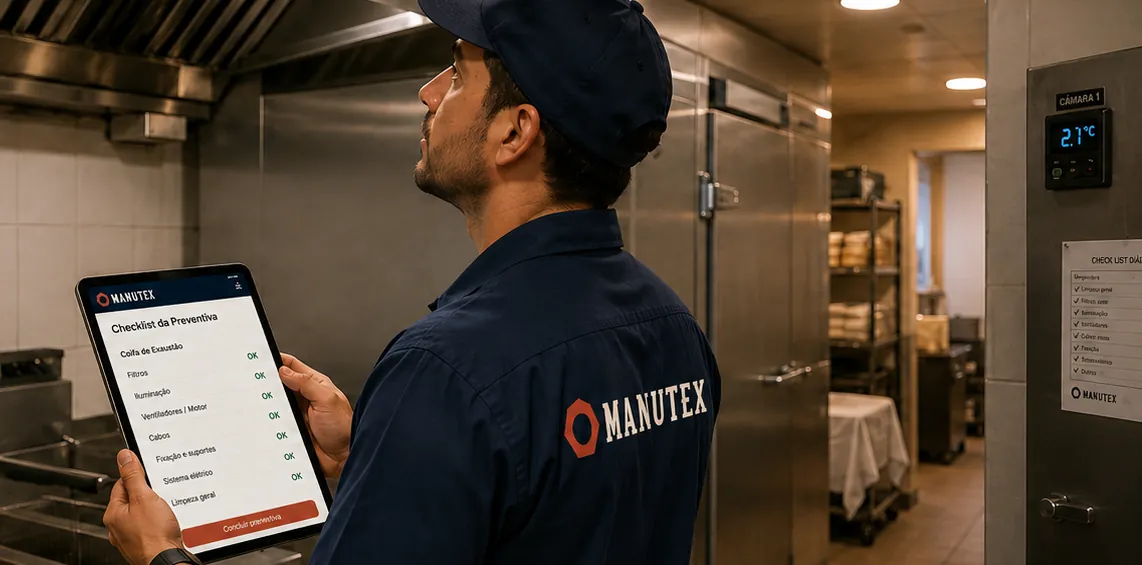
Manutex was designed from actual building condition surveys: equipment with a history of repeat failures, a ticket that starts life in a WhatsApp thread, preventive work nobody remembers to open. Every module went live solving a problem that already existed — not filling a demo screen.
- 8
- modules live in production
- 1475
- automated tests
- 138
- end-to-end scenarios
- 4
- roles, with tenant isolation in the database
These numbers describe the system, not the outcome of your contract. We do not publish response time, avoided cost or uptime: those would be estimates, and an estimate on a sales page is a guess in good typography. When a closed cycle can support such numbers, they will be published with the methodology attached.
The usual
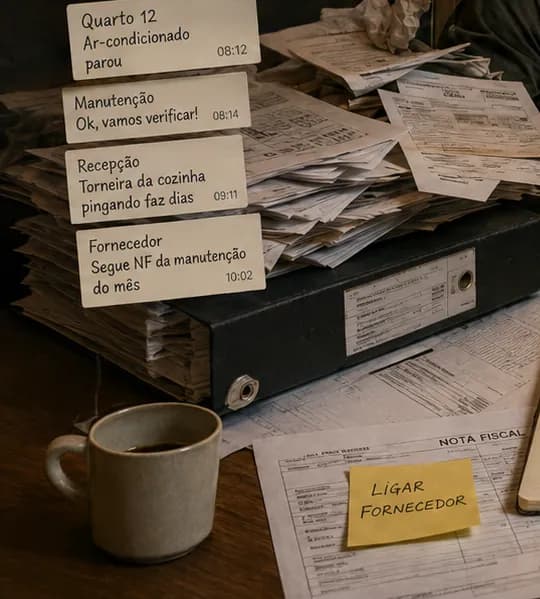
Maintenance lives in WhatsApp, in a spreadsheet, and in one person's head.
Nobody complains while it works. The bill arrives when that person leaves, the equipment stops, or the insurer asks for proof.
History that disappears
The technician fixed it, sent a voice note to the group and left. Six months later nobody knows what was replaced, by whom, or what it cost.
Preventive work always late
The plan exists on paper. The work order only appears when someone remembers — and that someone is the busiest person on site.
Spending with no trail
The invoice was paid, the budget was not. Nobody can say what a machine cost to keep this year, so nobody decides when to replace it.
The same failure, again
With no per-asset history, a recurring fault looks new — and gets diagnosed from scratch every time, paying for the call-out every time.
How the system works
From a loose signal to proof it was solved.
Six steps. Each one leaves a record, and none of them depends on someone remembering.

- 01
Capture
A ticket opened on a phone with a photo, dictated by voice, or extracted from a document the operation already had.
- 02
Understand
Area, asset, category, technical discipline and priority — proposed by the system, confirmed by a person.
- 03
Organise
It becomes a corrective ticket, a preventive plan, an asset occurrence or an alert, whichever fits.
- 04
Act
Owner, deadline, priority, supplier and responsibility matrix set on the ticket itself.
- 05
Verify
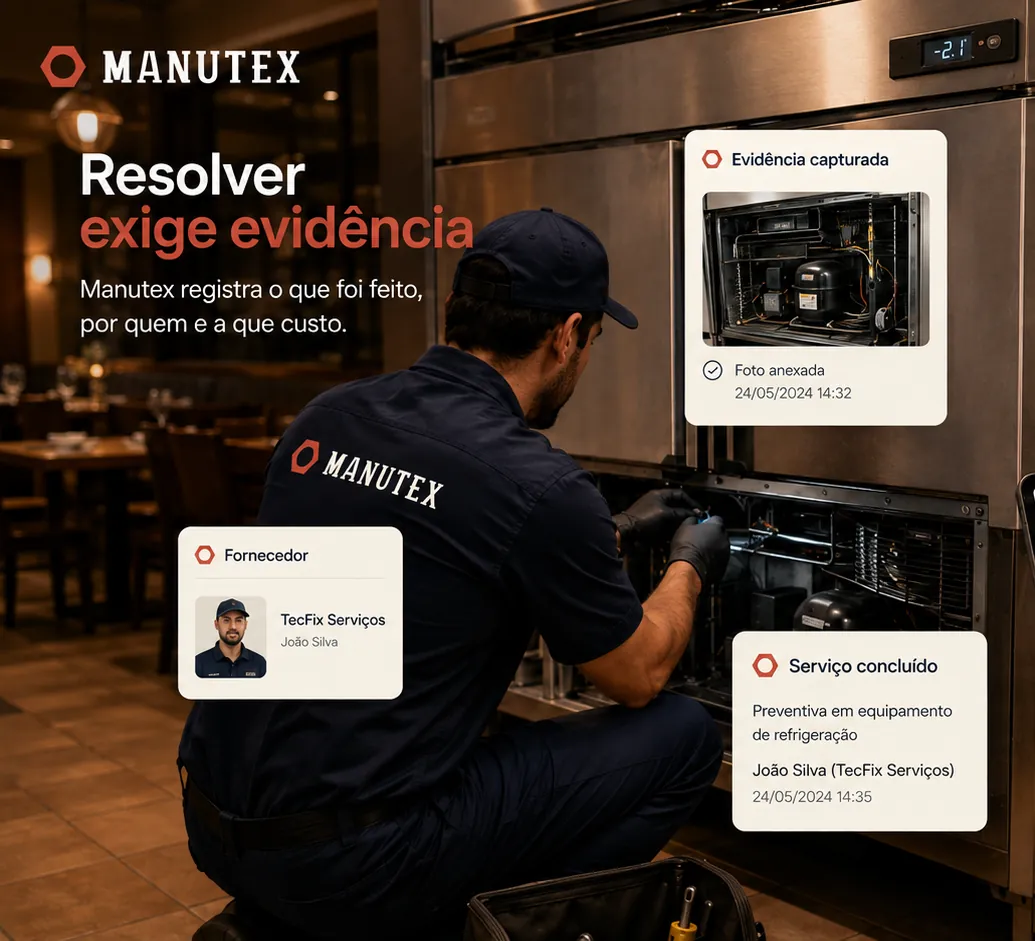
Resolving requires attached evidence. There is no closing a ticket by typing “done”.
- 06
Learn
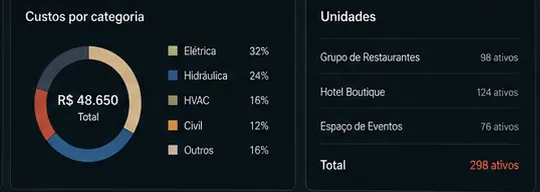
Per-asset history, cost by category, recurrence and preventive compliance become dashboard indicators.
Modules
Everything the operation needs, in one place.
Every module below is live today, in production — none of it is a roadmap promise.
Tickets with evidence
Seven states, priority, deadline, emergency flag with written justification, comments, responsibility matrix and full history. Resolving requires an attachment.
Assets with memory
Technical profile, versioned documents, occurrences, alerts with per-person read receipts, costs and asset-tag control.
Automatic preventive work
Eight frequencies. Orders are generated inside the database on a schedule — a forgotten plan produces one order, not thirty.
Cleaning
Same engine as preventive work, its own view, with checklist and materials. One order counts in both modules without being executed twice.
Costs
Entries by category, budget versus actual, monthly trend, anomaly flags and attached invoices.
Management dashboard
Five maintenance indicators with editable targets and twelve clickable charts — every number opens the already-filtered list.
Team and access
Four roles, page-level access per person, per-site scoping and bulk user import from a spreadsheet.
Audit trail
Append-only record of who changed what and when. Nothing is deleted; records are deactivated, never removed.
What makes it different
An agent that reads what your operation already produces.
Most maintenance software starts when somebody types a ticket. Manutex starts earlier: in the file that already exists.
Drop the mess, get drafts back
WhatsApp group exports (the whole .zip included), inspection spreadsheets, Word documents and PDF reports. The agent separates what is a maintenance problem, proposes title, area, asset, priority and deadline, and keeps the literal excerpt it took each one from.
Speak instead of typing
Record the audio, the system transcribes it and pre-fills the ticket form. Whoever is standing in front of the leak should not have to stop and write.
The policy becomes preventive work
The insurance PDF is read and the OBLIGATIONS it places on you become preventive suggestions — each with the literal clause shown next to it.
Ask the archive
The agent queries assets, tickets, occurrences, preventive plans, suppliers and the text of indexed manuals. It answers citing its source, separates recorded fact from hypothesis, and writes nothing: at most it prepares a draft for you to confirm.
Every Manutex proposal goes through human approval before it becomes a record. AI spend has a monthly ceiling per customer and every call is logged with its cost.
Why trust it
The control is in the architecture, not in the promise.
Isolation proven at runtime
Each organisation only sees its own data, enforced by database policy — and that is verified by an automated test against the real project, not by code review.
Human approval is mandatory
No AI route writes to the database. What it produces is a draft; turning it into a record takes a click from someone with permission.
Proof of execution
Resolving a ticket requires attached evidence, and every registry change lands in a trail that cannot be edited or deleted.
AI spend ceiling
A monthly limit in dollars per organisation, checked before every call. Consumption is visible per customer, with the provider's real cost — never an estimate.
Ready to get maintenance out of WhatsApp?
A 30-minute conversation and a demo using your operation's real data, not sample data.
Create your account, upload your spreadsheets and WhatsApp group — the system arrives already set up. No credit card.